

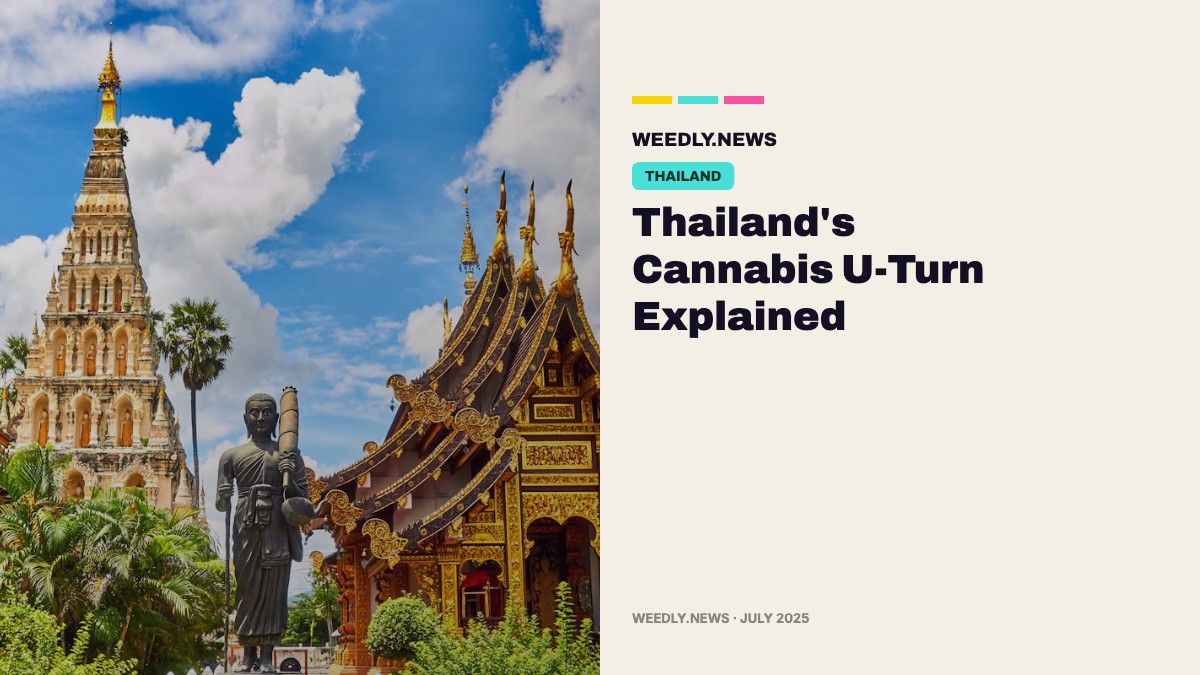
Thailand became the first country in Asia to decriminalize cannabis in 2022, unleashing a fast-growing dispensary and tourism boom — but with no comprehensive law to govern it, the government has since moved to restrict cannabis back toward medical-only use, leaving thousands of businesses and the wider region watching an extraordinary policy U-turn unfold.
The 2022 decriminalization shock
In June 2022 Thailand removed cannabis from its narcotics list, an unprecedented move for Asia, a region known for some of the world’s harshest drug laws. The change was driven partly by a push to promote cannabis and hemp as cash crops and medical products. Almost overnight, cannabis cultivation and sale became broadly permissible, and the country’s relationship with a plant long treated as a serious crime was transformed.
A boom with no rulebook
The decriminalization outpaced legislation. Thailand lifted the prohibition before passing a comprehensive cannabis act to regulate recreational use, creating a vacuum in which thousands of dispensaries, cafes and cultivation businesses opened rapidly, particularly in Bangkok and tourist hubs. The absence of clear rules on recreational use, potency, advertising and age limits became the defining problem of the Thai experiment.
The tourism and business explosion
Cannabis dispensaries proliferated across tourist areas, and Thailand quickly gained a reputation as an unexpected cannabis destination. Entrepreneurs invested heavily, and the sector generated jobs and revenue. But the freewheeling scene, with easy access and visible public consumption, alarmed officials and parts of the public who felt the change had gone far beyond the intended medical and economic goals.
Public backlash and concerns
Concerns mounted over youth access, recreational use by tourists, and the lack of controls, with medical professionals and some officials warning about health impacts and the message sent to young people. The government that enabled decriminalization had framed it around medical and economic use, and critics argued the reality had become de facto recreational legalization without safeguards.
The move to recriminalize
Amid the backlash and political change, Thai authorities signaled a sharp reversal, moving to restrict cannabis sales to medical purposes and requiring prescriptions, effectively trying to roll back the recreational scene that had flourished. This U-turn threatened the survival of many businesses that had launched in good faith during the open period, and injected deep uncertainty into the sector.
An industry in limbo
For the thousands of dispensaries and growers that emerged after 2022, the shift toward medical-only rules created existential uncertainty. Operators faced the prospect of new licensing requirements, prescription mandates and possible closure, and many called for clear, stable regulation rather than repeated reversals. The whiplash between openness and restriction became the industry’s central challenge.
The missing comprehensive law
At the heart of Thailand’s turmoil is the failure to pass a stable, comprehensive cannabis law defining exactly what is permitted. Successive draft bills stalled amid political change, leaving policy to be steered by ministerial announcements and regulations rather than durable legislation. This instability is the root cause of the sector’s volatility and the public confusion around what is actually legal.
Medical cannabis as the anchor
Throughout the turbulence, medical cannabis has remained the officially favored use. Thailand has genuine medical and traditional-medicine interest in cannabis, and the recriminalization push is framed as returning the plant to that intended role. A prescription-based medical system may prove to be the stable core that survives the political back-and-forth over recreational use.
Regional implications
Thailand’s experiment is closely watched across Asia, where strict prohibition remains the norm in countries like Singapore, Japan and Indonesia. A messy U-turn may reinforce regional caution, giving ammunition to governments wary of reform, while a stable medical framework could offer a template. Either way, Thailand has already shattered the assumption that Asian cannabis liberalization was unthinkable.
Lessons from the Thai experience
The clearest lesson is sequencing: decriminalizing before regulating invites chaos. Thailand’s boom-then-restriction cycle illustrates the risks of removing prohibition without a ready legal framework to govern the market, a cautionary tale reformers elsewhere cite when arguing for regulation-first approaches.
What tourists should know
Given the shifting rules, visitors should be cautious and check the current legal status before assuming access, as the environment can change quickly and public consumption may carry penalties. What was openly available one season may be restricted the next, making Thailand’s cannabis landscape one of the most fluid in the world.
The road ahead
Thailand’s future depends on whether it can finally pass durable legislation that reconciles its medical and economic ambitions with public-health concerns. Until then, the country remains a live experiment in how a society manages the aftermath of a sudden, poorly sequenced cannabis liberalization, and the outcome will influence attitudes far beyond its borders.
Legalization status by the numbers
- Thailand: First Asian country to decriminalize cannabis (2022); policy since shifting back toward medical-only use
- Japan: Strict prohibition; limited medical CBD/cannabis-derived framework
- Singapore: Among the world’s harshest drug laws; cannabis strictly illegal
- South Korea: Medical cannabis permitted in limited forms; recreational banned
- Malaysia: Cannabis illegal; debate over medical use emerging
Why sequencing matters for reformers everywhere
The Thai case has become a global reference point in debates over how to legalize responsibly. Reform advocates who once pointed to Thailand as proof that even strict-prohibition regions could change now cite it as a warning about the dangers of removing prohibition before a regulatory framework is ready. The lesson resonates from Europe to the Americas: legalization is not a single act but a system of licensing, testing, taxation, age verification and enforcement that must exist before the market opens. Without that scaffolding, a policy meant to reduce harm can instead create confusion, undermine public confidence and hand opponents evidence that reform breeds chaos. Thailand’s experience suggests that the countries with the smoothest transitions are those that built the rulebook first and lifted prohibition second.
The human cost of policy whiplash
Beyond the headlines, the repeated reversals have real consequences for ordinary people: entrepreneurs who invested life savings in dispensaries, farmers who switched crops, and workers who took jobs in a suddenly booming sector now face uncertainty. Patients who came to rely on accessible cannabis for medical reasons also worry about losing supply. This human dimension is a reminder that policy instability carries costs measured not only in economics but in livelihoods and health, and it strengthens the case for durable, predictable legislation over rule-by-announcement.
Related coverage on Weedly
- Cannabis In Australia Medical Market
- Uks Advisory Panel Suggests Increasing Hemps Thc Limit To 0 3 For Industry Growth
- Cannabis Legalization In Africa Does It Have Good Or Bad Impact
- Cannabis In India Bhang Tradition
- Cannabis And Driving Impairment Laws


