
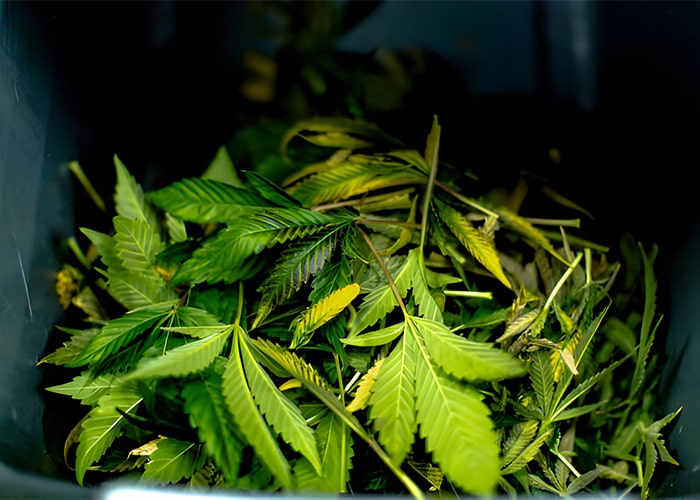
Emerging insights from Health Canada reveal that operators in the Canadian cannabis industry discarded a staggering 611.7 million grams (approximately 1.7 million pounds) of unpackaged cannabis flower and cannabis products in 2022 and the initial half of 2023, as detailed by MJBizDaily.
This figure constitutes roughly 16% of the total cannabis production in 2022. Although comprehensive data for the latter half of 2023 remains unavailable, the trends observed in the first six months hint that the industry may be gradually approaching a balance between supply and demand.
Farrell Miller, a renowned consultant in the cannabis industry, suggests that the primary cause for discarding packaged cannabis products is typically their age. This information is crucial for understanding the dynamics of product lifecycle management within the Canadian cannabis sector.
Canadian cannabis operators have now incinerated an astounding total of over 3.7 million pounds of cannabis and its by-products.
As the pioneer North American nation to decriminalize recreational cannabis in 2018, Canada has been grappling with a surplus production problem since the inception of the industry. Industry insiders attribute this phenomenon, at least partially, to the early valuation of publicly-traded cannabis corporations based on their production capacity rather than their sales performance.
Recent surveys shed light on the market dynamics. An October poll revealed that a significant 65% of Canadian cannabis users are sourcing their products from the legalized market. Additionally, a June 2023 report highlighted a whopping 157% growth in Canadian cannabis sales in the preceding two years.
Related on Weedly: Keep exploring the Weedly Glossary, our strain reviews, the Learn hub, our Canada coverage and our USA coverage.
Sources & further reading: For authoritative background see the World Health Organization, Wikipedia, Leafly Learn, the CDC and peer-reviewed studies on PubMed.
The bigger picture
Stories like this one, touching on canada’s massive cannabis disposal, are part of a fast-moving cannabis landscape in which policy, science, culture and commerce are all evolving at once. What happens in one market or corner of the industry often ripples outward, influencing consumers, businesses and lawmakers elsewhere. Keeping up with these developments helps readers understand not just isolated headlines but the broader direction of an industry still finding its shape. Cannabis remains a rapidly changing space, and following it closely, from legal shifts to product trends, offers a clearer view of where things may be heading next.
A note on legality and responsible use
Cannabis laws differ dramatically around the world and even between regions of the same country, so the single most important rule is to know and follow the rules where you are. Where cannabis is legal, responsible use means keeping consumption moderate and intentional, storing products safely away from children and pets, and never driving or operating machinery while impaired. Effects vary from person to person depending on dose, tolerance and individual physiology, so a measured, start-low approach is always wise. Treating cannabis with the same care and respect you would any substance helps keep the experience positive and safe.
Related reading on Weedly
- The Weedly cannabis glossary
- More from our News section
- Strain and product reviews
- International cannabis coverage
The bottom line
Topics like canada’s massive cannabis disposal are a small part of a large and fast-changing cannabis world, and staying curious and informed is the best way to navigate it. Whether your interest is practical, cultural or simply curiosity, understanding the context behind the subject helps you engage with it more confidently. As always, cannabis is for adults of legal age, laws vary by location, and responsible, moderate use should guide any personal choices. For more coverage across cannabis news, culture, science and the wider world, explore the rest of Weedly and our International section.
Quality, testing and knowing your source
Where cannabis is legal and regulated, one of the biggest advantages over the illicit market is quality control. Regulated products are typically tested for potency and for contaminants such as pesticides, mould and residual solvents, and they carry labelling that tells consumers what they are getting. Choosing tested products from legal, reputable sources is an important part of using cannabis safely. In the less-regulated corners of the market, particularly for some wellness and CBD products, quality and labelling can be inconsistent, so a little care in choosing where you buy goes a long way.
How the cannabis landscape keeps changing
Cannabis is one of the fastest-moving areas in law, science and culture today. Around the world, countries and regions are reforming their laws at very different paces, from full legalization to strict prohibition, and the industry and the research base are evolving alongside them. What is true in one place or one year may look quite different in another, which is why staying informed matters. Following these shifts, whether in policy, products or public attitudes, offers a clearer sense of where cannabis is heading. Our International coverage tracks how the picture differs from country to country.
Moderation and healthy habits
As with many things, moderation is central to a healthy relationship with cannabis. Using it intentionally rather than habitually, being mindful of how much and how often, and paying attention to how it fits with the rest of your life all help keep the experience positive. Regular heavy use can lead to tolerance, meaning effects diminish over time, and taking breaks can help reset that. Cannabis affects everyone differently, so self-awareness is key. Treating cannabis with the same thoughtfulness you would apply to any substance supports both enjoyment and wellbeing over the long term.
Cannabis and everyday life
For a growing number of adults, cannabis has become a normalized part of everyday life where it is legal, used much as some people use a glass of wine to relax or unwind. That normalization brings both opportunity and responsibility: the opportunity to enjoy cannabis openly and safely, and the responsibility to do so in ways that respect the law, other people and one’s own health. Keeping products stored securely away from children and pets, never consuming before driving, and being considerate about where and when you use are simple habits that make legal cannabis work smoothly in daily life.
Separating fact from myth
Cannabis has long been surrounded by both exaggerated fears and overblown claims, and cutting through that noise is part of engaging with it sensibly. Some widely repeated beliefs do not hold up to scientific scrutiny, while genuine risks and benefits are sometimes overlooked. Relying on credible, evidence-based sources rather than hearsay or marketing helps build an accurate picture. As research continues to mature, our understanding of what cannabis can and cannot do keeps improving, making it worthwhile to stay curious, keep an open mind, and update your knowledge as better information becomes available.