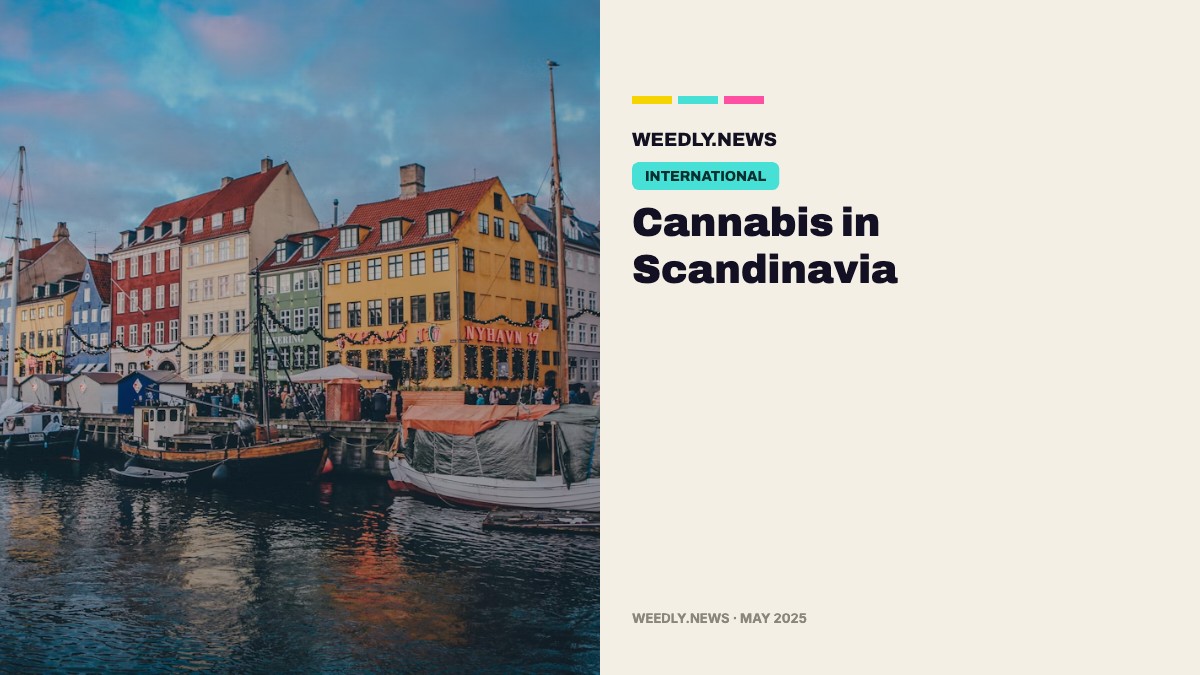
Scandinavia — Denmark, Sweden, Norway and Finland — is often imagined as socially progressive, but on cannabis the Nordic countries are among Europe’s most cautious, combining strict recreational prohibition with limited, carefully controlled medical access. From Sweden’s hardline zero-tolerance stance to Denmark’s contradictory relationship with Copenhagen’s famous Christiania, the region defies easy assumptions. Here is how cannabis policy works across Scandinavia, why these wealthy, liberal societies remain strict, and what distinguishes each country. First, our cannabis glossary explains the key terms.
Progressive societies, strict drug laws
A common surprise is that Scandinavia’s social progressivism does not extend to permissive cannabis policy. The Nordic countries have generally maintained restrictive drug laws rooted in a public-health philosophy that emphasizes reducing all drug use, and they have been slower than many to embrace liberalization. This reflects a distinct Nordic approach to drugs, prioritizing prevention and treatment within a framework that keeps recreational cannabis illegal. Understanding this philosophy is key to understanding why some of the world’s most socially liberal countries take a firm line on cannabis. For the regional context, see our International desk.
Sweden: the zero-tolerance stance
Sweden is among the strictest countries in Europe on cannabis, famous for its zero-tolerance drug policy. The country has long pursued a goal of a drug-free society, with tough laws and enforcement against cannabis use, possession and supply. Sweden’s approach is philosophically opposed to normalization, and it has been a vocal advocate for restrictive drug policy internationally. Recreational cannabis is firmly illegal, and even personal use is treated seriously. Sweden represents the hardline end of the European spectrum, a deliberate contrast to reforming countries. Our news coverage follows European policy contrasts.
Denmark and the Christiania contradiction
Denmark presents a fascinating contradiction centered on Christiania, the self-governing Copenhagen community historically known for its open cannabis trade on “Pusher Street.” For decades, cannabis was sold openly there despite being illegal, creating a famous grey zone. However, Denmark’s authorities and even the Christiania community itself moved to shut down the open cannabis market amid concerns about crime and gang activity. Denmark thus combines strict national prohibition with the legacy of one of Europe’s most famous cannabis markets — a tension that captures the country’s complicated relationship with the plant. Denmark also permits medical cannabis under a program.
Norway’s evolving approach
Norway has traditionally maintained strict drug laws, but it has shown signs of shifting toward a more health-oriented approach, with debates about decriminalizing personal drug possession and treating use as a health issue rather than a crime. Reform proposals aimed at decriminalization reflected a move toward the Portuguese-style philosophy, though the extent of change has been contested and gradual. Norway permits medical cannabis in limited forms. Its evolving stance suggests some movement within the Nordic model toward harm reduction, even as recreational legalization remains off the table. The direction of Norwegian policy is worth watching.
Finland’s strict framework
Finland maintains a strict prohibitionist framework for recreational cannabis, consistent with the broader Nordic emphasis on restrictive drug policy. Possession and use are illegal, and the country has not moved toward recreational legalization. Finland permits limited medical cannabis access. Like its neighbors, Finland combines a socially advanced society with cautious drug laws, reflecting the regional consensus that prioritizes prevention. There has been public debate and some citizen initiatives around cannabis, but these have not translated into major legal change, leaving Finland firmly in the strict camp.
The medical exception
Across Scandinavia, medical cannabis exists but in limited and carefully controlled forms. Denmark established a medical cannabis pilot program, and other Nordic countries permit certain medical cannabis or cannabis-derived products under regulation. However, medical access tends to be more restricted than in countries like Germany or Australia, reflecting the region’s cautious approach. Patients can access medical cannabis in specific circumstances, but the programs are narrower, and the overall Nordic stance treats cannabis with more reservation than many other Western nations. Our Learn section covers medical cannabis.
The public-health philosophy
The defining feature of Scandinavian drug policy is its public-health philosophy, which emphasizes minimizing drug use overall and providing treatment and prevention. This framework views cannabis primarily through the lens of potential harm and prioritizes keeping use low, rather than regulating a legal market. It is a coherent, deliberate approach rooted in Nordic social values around collective welfare. Whether one agrees with it or not, it explains why these countries resist the legalization trend: their goal is reduced use, and they see prohibition, paired with treatment, as serving that aim.
Why Scandinavia resists the trend
As much of Europe liberalizes, Scandinavia’s continued caution stands out. The region’s resistance stems from its distinct drug-policy tradition, cultural attitudes, and the influence of countries like Sweden that strongly advocate restriction. There is reform debate — particularly around decriminalization in Norway and questions about the effectiveness of strict policies — but the Nordic consensus has held more firmly than in Central or Western Europe. This makes Scandinavia a notable counterexample to the legalization wave, demonstrating that progressive societies can choose caution on cannabis.
What visitors should know
Travelers should treat all Scandinavian countries as strict on recreational cannabis. It is illegal across the region, enforcement can be firm (especially in Sweden), and there are no legal recreational markets. The old image of open sales at Christiania is outdated, as that market was shut down. Medical cannabis is limited and for authorized patients. As everywhere, carrying cannabis across borders is illegal. Visitors should exercise caution and not expect tolerance. For deeper background, see the overview of cannabis in Denmark.
Where Scandinavia sits globally
No Scandinavian country appears among the nine that fully legalized recreational cannabis in widely cited global tallies. The region sits among nations with strict recreational prohibition and limited medical access, with Sweden at the hardline end. Scandinavia represents a distinct, cautious model, showing that the global legalization trend is far from universal even among wealthy, socially progressive nations.
The bottom line
Scandinavia defies the assumption that socially progressive societies embrace cannabis: the Nordic countries maintain strict recreational prohibition and limited medical access, guided by a public-health philosophy of minimizing drug use. Sweden is the hardline example, Denmark carries the complicated Christiania legacy, and Norway shows some movement toward harm reduction. For visitors, the region is strict, and recreational access is unavailable. As always, verify current rules before acting, and never carry cannabis across borders. This article is informational, for adults of legal age; verify local legality before acting on it.