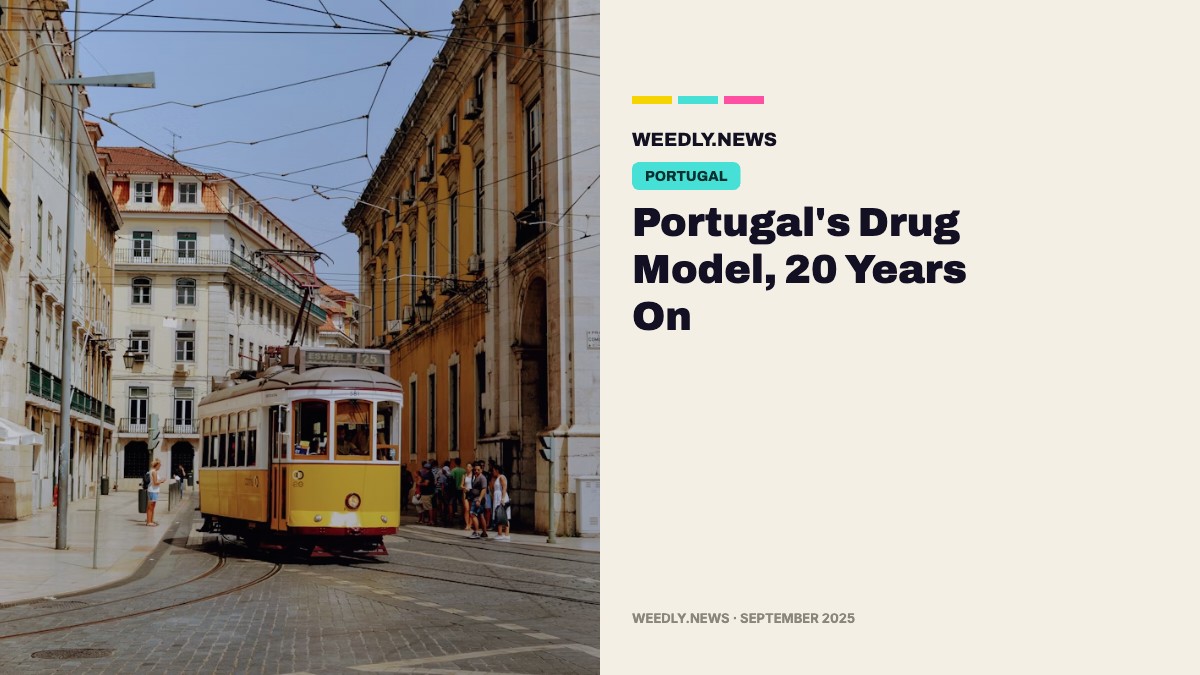
Portugal made history in 2001 by decriminalizing the possession of all drugs, including cannabis, and treating personal use as a public-health matter rather than a crime — a radical shift that, two decades on, is widely studied as a model of harm reduction and offers distinct lessons for how societies can approach cannabis without either full prohibition or a commercial legal market.
The 2001 decision
Facing a severe drug crisis, Portugal took the then-radical step of decriminalizing the possession and use of all drugs for personal use in 2001. Rather than legalizing drugs, it reclassified personal possession as an administrative offense handled outside the criminal-justice system. This reframed drug use as a health and social issue, redirecting people who use drugs toward treatment and support instead of prosecution and prison, a philosophy that set Portugal apart from nearly every other country at the time.
How the model works
Under Portugal’s system, someone caught with a small quantity of any drug is not arrested but may be referred to a “dissuasion commission,” a panel of health and social professionals that assesses the individual and can recommend treatment, education or, in some cases, minor administrative measures. The emphasis is on understanding and addressing use rather than punishing it, with resources channeled into prevention, treatment and harm reduction rather than incarceration, fundamentally altering the state’s relationship with people who use drugs.
Cannabis within the model
Cannabis, as the most widely used illicit drug, is central to Portugal’s decriminalization. Possession of small amounts for personal use is not a criminal matter, sparing users criminal records and freeing police and courts from minor cases. However, decriminalization is not legalization: selling and large-scale cultivation remain illegal, and there is no regulated commercial market. Portugal’s approach thus removes the criminal penalties on users while leaving supply in the illicit realm, a distinct middle path.
Public-health results
Portugal’s model is often credited with public-health improvements following its implementation, including reductions in drug-related harms such as overdose deaths and HIV transmission among people who inject drugs, alongside increased uptake of treatment. While cannabis-specific effects are harder to isolate and debates about attribution continue, the overall experience is widely viewed as demonstrating that a health-focused, decriminalized approach can reduce harm without causing the surge in use that critics feared, informing drug-policy debates worldwide.
Not a commercial market
A key point often misunderstood is that Portugal did not create a legal cannabis industry. Unlike Canada or US states, there are no cannabis shops or regulated recreational sales; the reform focused on decriminalizing users, not commercializing the drug. This distinguishes Portugal’s model from legalization and makes it a reference for those who favor ending criminal penalties on use while remaining cautious about commercial markets, a position with broad international appeal.
Medical cannabis and hemp
Separately from decriminalization, Portugal legalized medical cannabis and became a significant location for licensed cannabis cultivation, attracting international companies drawn by its climate and regulatory framework to grow cannabis for medical and export markets. This medical-industrial dimension operates alongside the decriminalization model, giving Portugal a dual identity: a pioneer of health-focused drug policy and a growing hub for legal medical cannabis production aimed at European and global markets.
Global influence
Portugal’s decriminalization became one of the most cited examples in international drug-policy debate, studied by governments and advocates considering reform. It demonstrated that removing criminal penalties for possession need not lead to catastrophe and could yield public-health benefits, influencing discussions from the Americas to other parts of Europe. The Portuguese model gave reformers a real-world, long-running example to point to, shaping how many think about alternatives to prohibition, including for cannabis specifically.
Challenges and criticism
Portugal’s model has faced challenges over the years, including debates about funding for treatment services, evolving drug-use patterns, and questions about whether the system’s success has been sustained amid budgetary pressures. Critics note that decriminalization leaves supply illegal and does not address all harms, while some argue results have varied over time. These critiques are part of an honest assessment, but the core approach has endured and retained substantial support both domestically and internationally.
Cannabis-specific lessons
For cannabis policy specifically, Portugal shows that decriminalizing use can spare millions from criminal records and refocus resources on health without legalizing commerce. It offers a template for countries not ready for full legalization but seeking to end the criminalization of users. At the same time, it highlights the limitation that decriminalization alone does not regulate supply or capture tax revenue, a gap that legalization models like Canada’s address differently.
How Portugal compares
Portugal sits distinctively among reformers: more health-focused and comprehensive in decriminalization than most, yet without the commercial legal market of Canada, Uruguay or US states. It is often paired with these as one of the pioneering approaches to drug policy, representing the harm-reduction, decriminalization end of the spectrum. Its dual role as decriminalization pioneer and medical cannabis producer gives it a nuanced position in the global landscape.
The bottom line
Two decades on, Portugal’s decision to decriminalize all drugs and treat use as a health issue remains a landmark in global drug policy, offering enduring lessons for cannabis: that ending criminal penalties on users is feasible and can support public health, even without a commercial market. As countries worldwide debate how to move beyond prohibition, Portugal’s health-centered model continues to inform and inspire the conversation about a smarter approach to cannabis.
Legalization status by the numbers
- Portugal: Decriminalized possession of all drugs, including cannabis, in 2001; use treated as health issue; medical cannabis and export cultivation legal; no recreational market
- Netherlands: Coffeeshop tolerance; regulated supply trial underway
- Germany: Adult possession and home growing legal since 2024
- Spain: Private use tolerated; cannabis social clubs in grey zone
- Switzerland: Regulated cannabis sales pilots underway
Related coverage on Weedly
- Icbc Berlin 2025 Exciting Return In April
- Where Is Cannabis Legal A Country By Country Global Status Guide
- Cannabis Legalization Public Health Evidence
- Cannabis Legalization Youth Use Evidence
- Israel Pioneer Medical Cannabis Research