


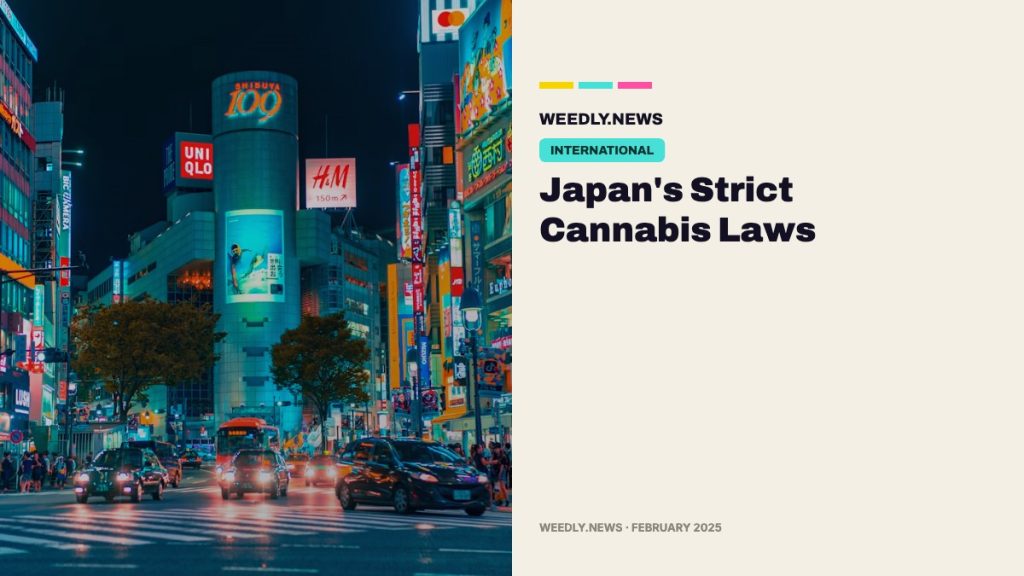
Japan has some of the strictest cannabis laws in the developed world — possession and use can carry serious criminal penalties, and the country enforces its rules even against citizens who use cannabis abroad. Yet even here, change is creeping in: Japan recently created a narrow legal path for cannabis-derived medicines while tightening the rules around use, and a regulated CBD market has taken hold. For anyone traveling to or living in Japan, understanding just how strict — and how nuanced — these laws are is essential. Here is the full picture. First, our cannabis glossary defines the key terms.
Among the world’s toughest laws
Japan treats cannabis as a serious criminal matter. Possession, cultivation and trafficking can lead to significant prison sentences, and the social stigma attached to cannabis is intense — arrests of celebrities or public figures become major scandals. Unlike much of the West, Japan has seen little of the liberalizing trend, and public attitudes remain broadly conservative on the issue. This makes Japan one of the clearest examples of a wealthy, developed nation maintaining strict prohibition even as neighbors and Western countries reform. For the global contrast, see our International desk.
The overseas-use rule
One of Japan’s most striking features is that its cannabis prohibition has, in effect, reached beyond its borders. Japanese law has historically been applied so that nationals could face consequences for cannabis use even when it occurred in countries where it is legal. This extraterritorial dimension means a Japanese citizen using cannabis legally in, say, Canada or a US state could still run into trouble under Japanese rules. It is a powerful illustration of how seriously Japan treats the substance, and a crucial warning for Japanese nationals traveling abroad.
The 2023-2024 legal changes
Japan did update its cannabis laws relatively recently, in a reform that cut two ways. On one hand, it created a legal pathway for cannabis-derived pharmaceutical medicines — allowing approved cannabis-based drugs for the first time. On the other hand, it tightened enforcement by introducing or clarifying penalties around use itself, closing perceived loopholes. The net effect was to modernize the framework toward medical pharmaceuticals while reinforcing, rather than relaxing, the country’s tough stance on recreational use. Our news coverage follows these shifts.
The CBD exception
Amid the strictness, CBD (cannabidiol) has carved out a legal niche in Japan. CBD products derived from permitted parts of the cannabis plant and containing no detectable THC have been legally sold, and a wellness market for CBD oils, cosmetics and drinks has grown. The rules are exacting — products must comply with strict THC-free requirements and sourcing standards — but they have allowed a legitimate CBD sector to flourish. This makes Japan a notable case where a strict-prohibition country nonetheless permits a carefully bounded cannabinoid market.
Why Japan resists reform
Several factors underpin Japan’s conservative stance: strong cultural and social norms against drug use, an intense stigma reinforced by media coverage, and a legal-political establishment cautious about liberalization. Cannabis has historically been associated with criminality and moral concern rather than medicine or lifestyle, and there has been little of the grassroots reform movement seen elsewhere. As a result, the pressures that drove change in North America and Europe have been far weaker in Japan, and prohibition retains broad support. Our Learn section explores how attitudes shape policy.
The historical context
Cannabis was not always so taboo in Japan. Hemp has deep roots in Japanese history and culture, used traditionally in textiles, rope and religious contexts. Strict prohibition largely dates to the mid-twentieth century, when cannabis was brought under tight legal control. This history means that Japan’s relationship with the plant is more complex than its current strictness suggests, and hemp’s cultural legacy occasionally features in debates about the country’s approach. Understanding this background adds nuance to the picture of blanket prohibition.
What travelers must know
For visitors, the rules are unambiguous and unforgiving: do not bring cannabis into Japan, do not use it there, and do not assume that a product legal at home is acceptable. Even CBD products should be approached carefully, since anything containing THC could cause serious legal problems. Customs enforcement is strict. The safest approach for any traveler is to leave all cannabis products behind entirely. Japan is not a place to test the limits of drug law, and the penalties for getting it wrong are severe.
The medical pathway in practice
The new medical pathway focuses on approved, pharmaceutical-grade cannabis-derived medicines rather than the broad medical-cannabis programs seen in countries like Australia or Canada. This means access is narrow and tied to specific approved products and conditions, not a general prescription system. It is a meaningful step — Japan moving from zero medical access toward a regulated pharmaceutical route — but it should not be mistaken for the kind of wide medical legalization found elsewhere. The distinction matters for patients and observers alike.
Japan in the Asian context
Japan’s strictness is broadly consistent with much of Asia, where cannabis penalties are among the world’s harshest. Yet the region is not monolithic: Thailand dramatically liberalized in 2022, and countries like South Korea and Japan have created narrow medical or CBD pathways. Japan sits toward the strict end of this spectrum, modernizing only cautiously around pharmaceuticals and CBD while holding the line on recreational prohibition. This makes it a key reference point for how a conservative, developed Asian nation manages cannabis.
Where Japan sits globally
Japan is nowhere near the group of nine countries that fully legalized recreational cannabis, as shown in widely cited global tallies. It represents the strict-prohibition end of the spectrum, now softened only slightly by a pharmaceutical medical pathway and a legal CBD market. For deeper background, the overview of cannabis in Japan traces the country’s laws, the recent reforms and hemp’s historical role.
The bottom line
Japan maintains one of the developed world’s strictest cannabis regimes: harsh penalties, an extraterritorial reach that can affect citizens who use abroad, and deep social stigma. Recent reforms opened a narrow pharmaceutical medical pathway and reinforced enforcement, while a bounded, THC-free CBD market thrives. For travelers and residents, the message is simple — treat cannabis as strictly off-limits in Japan. As always, verify current rules carefully, because in Japan the consequences of getting it wrong are severe. This article is informational, for adults of legal age; verify local legality before acting on it.