


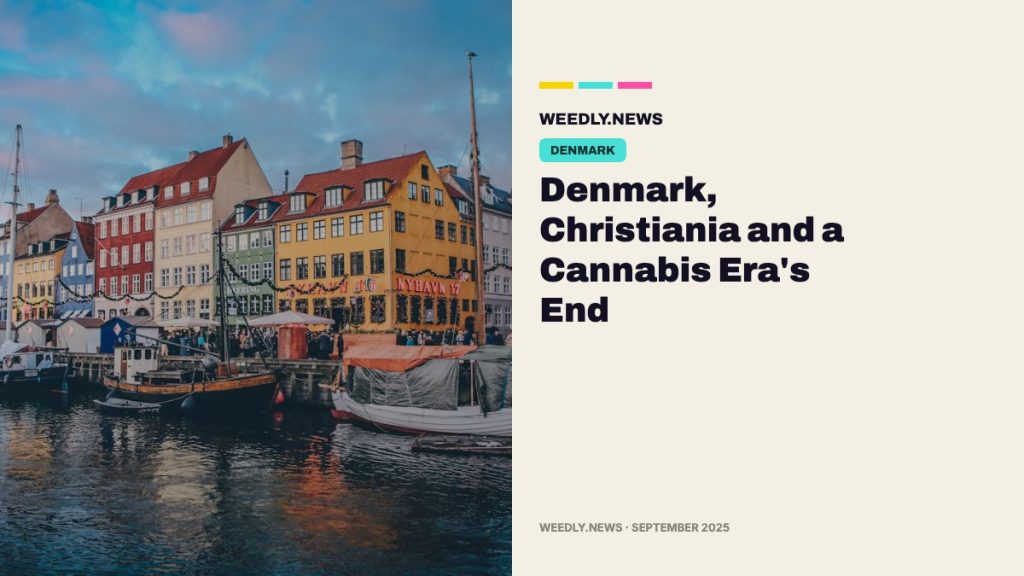
For decades, the freetown of Christiania in Copenhagen was internationally famous for its open cannabis trade on the notorious Pusher Street, an anomaly in a country with otherwise strict drug laws; when residents themselves finally dug up the street to end the trade, it marked a turning point in Denmark’s complicated relationship with cannabis — one defined by prohibition, a legal medical program, and recurring debates over reform.
The Christiania anomaly
Christiania, a self-governing community established in a former military area of Copenhagen in the 1970s, became known worldwide for its open cannabis market on Pusher Street, where dealers sold hashish and cannabis openly despite Danish law. For decades this created a paradox: a visible, tolerated-in-practice cannabis trade in a country that formally prohibited the drug. Christiania’s alternative culture and its cannabis market drew tourists and became a symbol of Denmark’s uneasy, contradictory stance on cannabis.
An open trade in a strict country
Denmark’s national drug laws are relatively strict, prohibiting cannabis and penalizing possession and sale, yet the Christiania market operated for years in defiance of these laws. Police periodically cracked down, but the trade persisted, entangled over time with organized crime and gang violence that increasingly plagued Pusher Street. This tension between strict formal law and the open reality at Christiania encapsulated the difficulty of Denmark’s approach and set the stage for eventual change.
Violence and the tipping point
Over the years, the cannabis trade on Pusher Street became linked to serious violence, including shootings connected to gang control of the lucrative market. This violence eroded the community’s tolerance and endangered residents and visitors. The escalating danger ultimately prompted Christiania’s own residents to take dramatic action, concluding that the open trade had brought crime and harm that outweighed any countercultural ideals, leading to a historic decision to end it.
Residents dig up Pusher Street
In a striking moment, Christiania’s residents themselves physically tore up the cobblestones of Pusher Street to dismantle the cannabis market and reclaim their community from the crime associated with it. This act, undertaken with public and police attention, symbolized the end of an era and a rejection of the open trade that had defined the freetown for decades. It reflected a grassroots decision that the market’s costs had become intolerable.
The aftermath and displacement
Ending the Pusher Street trade raised questions about where the market would go, with concerns that dealing would disperse into other parts of Copenhagen rather than disappear. This highlighted a persistent challenge of enforcement: shutting down one visible market does not eliminate demand or supply, which can relocate. The Christiania experience thus underscored the limits of suppression without addressing the underlying demand through regulation or alternative policy, a debate familiar across many countries.
Denmark’s medical cannabis program
Separately from the Christiania saga, Denmark established a medical cannabis pilot program, allowing patients with certain conditions to access cannabis-based treatments under medical supervision. This reflected a pragmatic acceptance of cannabis as medicine even as recreational prohibition continued, and Denmark also developed cannabis cultivation for medical and export purposes. The medical program represents the regulated, health-oriented side of Denmark’s cannabis policy, contrasting with the illicit trade that characterized Pusher Street.
Copenhagen’s reform debates
Copenhagen’s city government has at times advocated for experimenting with regulated recreational cannabis, arguing that a legal, controlled market could reduce the crime and violence associated with the illicit trade, including at Christiania. However, such proposals require national approval, and Denmark’s central government has not embraced them. This gap between a reform-minded city and a cautious national government mirrors dynamics seen elsewhere, leaving Copenhagen’s legalization ambitions unrealized.
Strict laws, ongoing use
Despite prohibition, cannabis use in Denmark is not uncommon, and the persistent demand sustained markets like Christiania’s for decades. This reality fuels arguments that strict enforcement has failed to eliminate use while enabling criminal control of supply. Reform advocates point to the violence at Pusher Street as evidence that regulation might better manage a market that exists regardless of legal status, though these arguments have not yet shifted national policy toward legalization.
Lessons from Christiania
The Christiania story offers pointed lessons: an open, unregulated cannabis market, even one embedded in an idealistic community, became a magnet for organized crime and violence, ultimately rejected by the very residents who once tolerated it. This illustrates the risks of leaving cannabis supply to the illicit market and the difficulty of managing it through either tolerance or suppression alone, informing debates about whether regulation offers a better path than the extremes Denmark experienced.
How Denmark compares
Denmark occupies a cautious position: stricter than reforming neighbors like Germany and without the tolerance model of the Netherlands, yet with an established medical program and a famous history of de facto tolerance at Christiania. Its experience, particularly the violent end of the Pusher Street trade, adds a distinctive chapter to the European cannabis story, highlighting the consequences of unregulated markets and the unresolved tension between prohibition and demand.
The bottom line
The dismantling of Christiania’s Pusher Street closed a remarkable chapter in Denmark’s cannabis history, ending decades of an open trade that had become synonymous with both counterculture and crime. It underscored the failures of leaving cannabis to the illicit market while Denmark maintains strict prohibition alongside a regulated medical program. Whether Denmark eventually embraces the regulated approach its capital has sought remains an open and consequential question.
Legalization status by the numbers
- Denmark: Cannabis illegal; famous open trade at Christiania’s Pusher Street dismantled by residents; medical cannabis pilot program established
- Netherlands: Coffeeshop tolerance; regulated supply trial underway
- Germany: Adult possession and home growing legal since 2024
- Sweden: Strict prohibition; zero-tolerance approach
- Norway: Moving toward decriminalization of personal drug use
A cautionary tale for the whole continent
A cautionary tale for the whole continent
Related coverage on Weedly
- Cannabis In India Bhang Tradition
- Cannabis And Driving Impairment Laws
- Cannabis In France Europes Holdout
- Switzerland Cannabis Pilot Programs Explained
- Icbc Berlin 2025 Exciting Return In April